

Arkwalletx

MPC-POWERED DIGITAL ASSET INFRASTRUCTURE

Use it, or build on it.

Arkwalletx ships as a working treasury application — accounts, approvals, risk controls, team roles — and as a WaaS API you can embed. Both run on the same MPC threshold-signing core.

  • 30+ Chains
  • 500+ Tokens
  • MPC + TEE
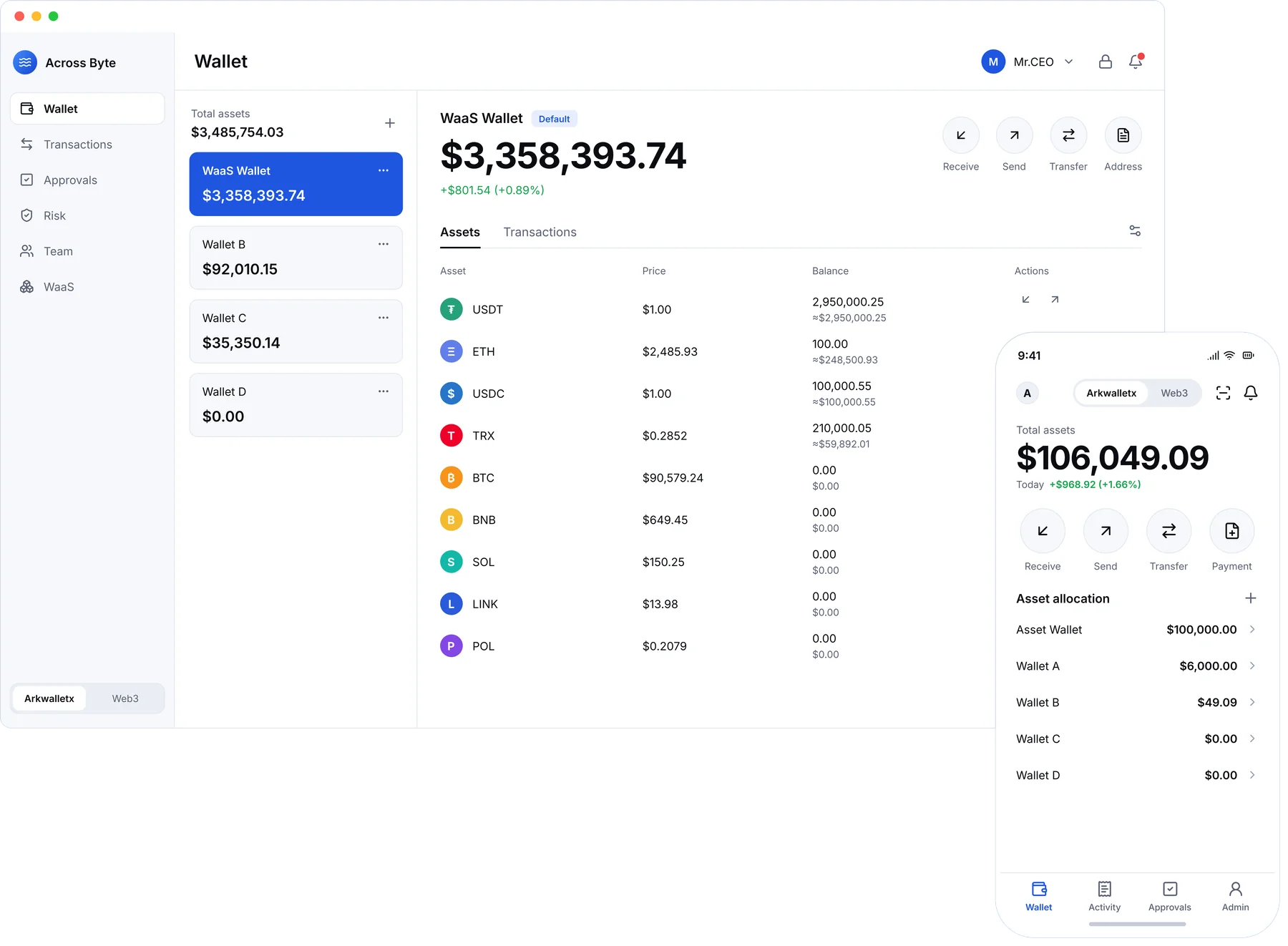
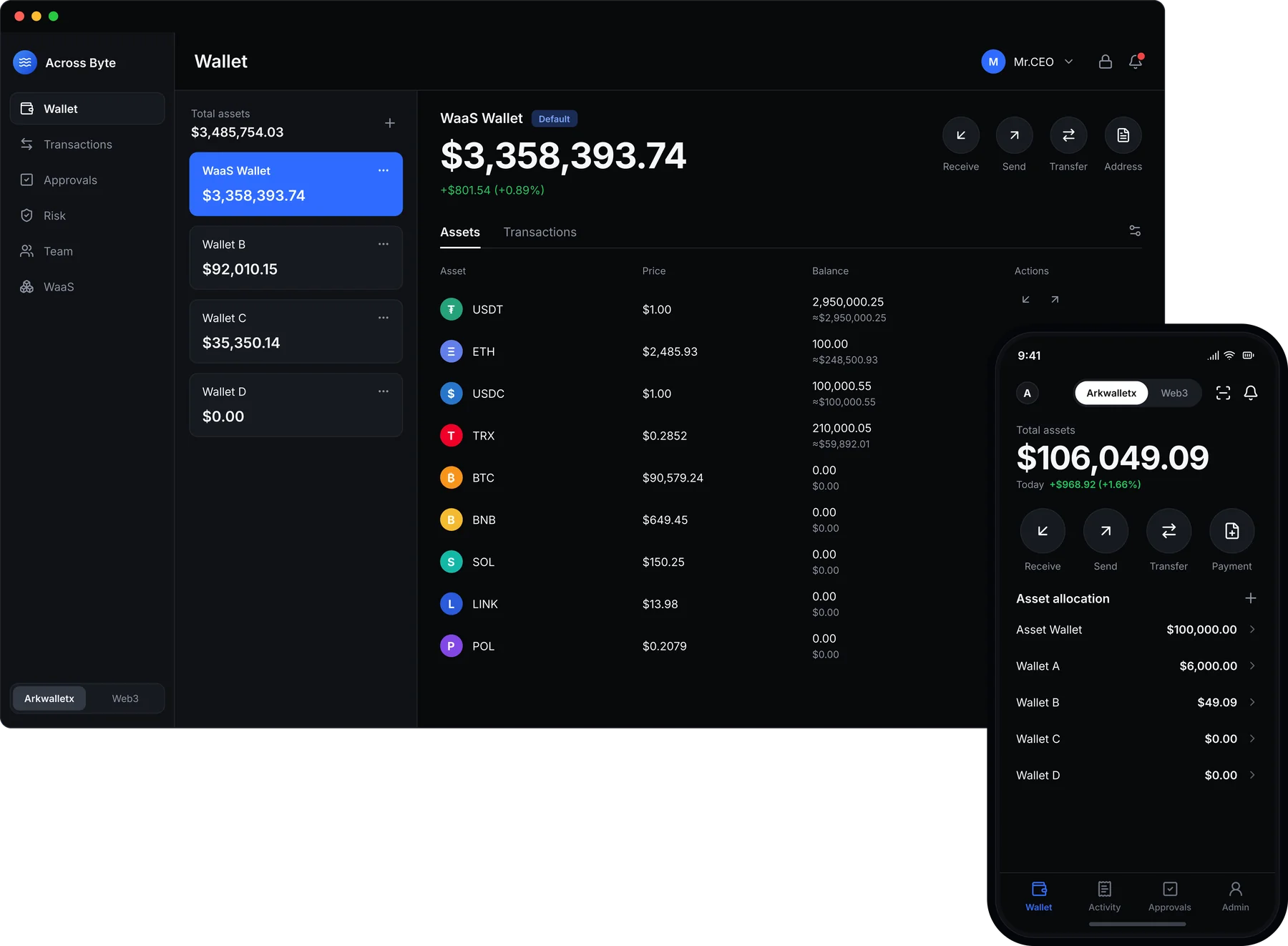
Arkwalletx treasury dashboard on desktop and mobile

Two ways in. One core.

Start with the product. Move to the API when you need to — your keys, policies and history carry over.

Arkwalletx Platform

Log in and start today

  • No development required — your finance team runs it directly
  • Treasury accounts, transfers, and multi-currency balances in one view
  • Approval flows, risk rules, and team permissions built in

Cross-border commerce · Payment providers · Crypto-native teams

Arkwalletx WaaS

Embed it in your own product

  • Unified API and SDK for wallet creation, signing, and callbacks
  • Same MPC core, same risk engine, exposed programmatically
  • Bring your own UI and user model

Trading platforms · Funds · Licensed institutions

Know where every dollar sits.

One view across every account, currency, and chain — updated as transactions settle.

Multiple treasury accounts

Separate accounts per business line, currency, or counterparty. Balances roll up; permissions don't.

Real-time balances

Total position and per-asset holdings, priced and refreshed continuously.

Full transaction history

Every inbound and outbound transfer, with on-chain reference and internal approver.

Reporting dashboard

Flows, holdings, and movement over time — exportable for reconciliation.

Custody doesn't mean handing over control.

Every transfer passes through rules you define — before it ever reaches a signer.

  • Multi-level approval by amount, asset, or destination
  • Role-based authority — who can initiate, who must approve
  • Every action logged with actor, timestamp, and outcome

The full private key has never existed.

Not on our servers, not on your device, not at any moment in the signing process. That's not a policy — it's how threshold cryptography works.

Signing requestSplit into n sharesTEE enclaveKey share 1 · sealed memoryTEE enclaveKey share 2 · sealed memoryTEE enclaveKey share 3 · sealed memoryThis share did not participateThreshold m-of-n2 of 3 shares cooperateValid signatureBroadcast on-chain
The full private key is never reconstructed — not at any step, not on any machine

Threshold MPC (m-of-n)

Signing requires m of n independent key shares to cooperate. No single share, and no single machine, can produce a valid signature.

TEE execution

Share computation runs inside a trusted execution environment. Memory is sealed — inaccessible even to the host operating system.

Distributed shares

Shares are stored across isolated environments with independent backup and recovery paths. Losing one is recoverable; compromising one is not enough.

What this means in practice: even Arkwalletx cannot move your assets outside the policies you set.

Who runs on Arkwalletx

Cross-border commerce

Platform

Collect from customers and pay suppliers in stablecoins, without a banking relationship in every market.

Payment service providers

Platform / WaaS

Accept crypto on behalf of merchants, settle on schedule, keep funds segregated per merchant.

Trading platforms

WaaS

Hot, warm, and cold separation with programmatic signing and per-desk limits.

Corporate treasury

Platform

Hold and move stablecoin reserves under board-approved policy, with an audit trail that survives review.

30+ chains. 500+ tokens.

30+

chains

500+

tokens

Mainstream networks and the stablecoins your counterparties actually use — USDT, USDC, and more, across every chain we support.

Available everywhere your team works.

Desktop for treasury operations, mobile for approvals on the move.

Frequently asked questions

Which businesses is Arkwalletx built for?

Companies that receive, hold, or send digital assets as part of normal operations — cross-border merchants, payment service providers, trading platforms, funds, and corporate treasuries. If your finance team currently handles crypto through personal wallets or exchange accounts, Arkwalletx is the replacement.

How long does integration take?

The Platform requires no integration — you can be operating the same day your account is provisioned. For WaaS, the path is: request API credentials → build against the sandbox → go live. Timeline depends on your scope; our engineering team scopes it with you before you commit.

How is pricing structured?

Pricing depends on custody volume, transaction throughput, and which capabilities you use. Contact our sales team for a quote based on your business.

Which cryptocurrencies are supported?

30+ mainstream chains and 500+ tokens, including USDT and USDC across all supported networks. Contact us for the current full list.

Can I manage multiple business lines separately?

Yes. Create a separate treasury account per business line, currency, or counterparty. Each carries its own balances, permissions, approval rules, and transaction history. They roll up for reporting but stay isolated operationally.

How does team collaboration work?

Members are assigned roles scoped to specific treasury accounts. Roles determine who can initiate transfers, who must approve them, and at what thresholds. Every action is logged with actor and timestamp, and access can be revoked with immediate effect.

Who holds the private keys?

No one holds a complete private key, including us. Signing uses threshold MPC: the key exists only as n independent shares, and producing a signature requires m of them to cooperate. Share computation happens inside trusted execution environments, where memory is sealed even from the host operating system. The full key is never reconstructed — not at any step, not on any machine.

Can Arkwalletx move my assets on its own?

No. Every transfer must satisfy the policies you configure — approval thresholds, allowlists, velocity limits — before it ever reaches a signer, and signing itself requires a threshold of independent key shares. We cannot move your assets outside the policies you set.

What happens if one key share is lost or compromised?

Shares are stored across isolated environments, each with an independent backup and recovery path. Losing one share is recoverable. Compromising one share is not enough to produce a signature, because signing requires m of n shares to cooperate.

Do you offer self-custody or co-managed custody?

No. Arkwalletx is custodial only. There is no self-custody mode and no co-managed mode in which you hold part of the key material. The protection against misuse comes from threshold cryptography and the policy engine described above, not from splitting custody with you.

What is a TEE and why does it matter here?

A trusted execution environment is an isolated region of a processor whose memory cannot be read by the host operating system or by anyone with access to the machine. Key-share computation runs inside one, so a share is never exposed in plain memory even to infrastructure operators.

What checks does a transfer pass before it is signed?

In order: policy validation against limits and allowlists, AML/KYT screening of the counterparty address, then multi-level approval according to your rules. Each of those stages can block the transfer. Only after all three pass does MPC signing begin — and once signing starts, the transfer cannot be recalled.

How do you prevent an insider from moving funds out?

Authority is split by role and scoped by wallet. The member who initiates a transfer is not the member who approves it, and neither necessarily holds signing authority. Approval thresholds by amount and destination mean a single compromised account cannot move material funds. Every action is logged with actor, timestamp and outcome.

What conditions can approval rules be based on?

Amount, asset, and destination address. Rules can require multiple levels of approval above given thresholds, and can be scoped to specific treasury accounts rather than applied blanket across the organisation.

Are risk-policy changes themselves controlled?

Yes. Creating, editing or deleting a risk policy goes through the same approval queue as a transfer, as does inviting a team member. Someone cannot quietly weaken the controls and then move funds through the gap.

How do I revoke access when someone leaves?

Remove the member and their access ends immediately — there is no propagation delay or session that keeps working. Their historical actions remain in the audit log.

Can I limit a member to specific wallets?

Yes. Members, roles and scopes are assigned per treasury account. A member can hold different roles on different accounts, and business lines are isolated from each other by default.

Is there a sandbox for API integration?

Yes. WaaS integration is built and tested against a sandbox environment before going live. The sequence is: request API credentials, build against the sandbox, then go live.

If I start on the Platform and later move to the API, do I lose anything?

No. Your keys, policies and transaction history carry over. The Platform and the WaaS API are two interfaces onto the same custody core and the same risk engine, not two separate products.

Can I export data for reconciliation?

Yes. Flows, holdings and movement over time can be exported from the reporting dashboard, and every transfer carries both its on-chain reference and the internal approver, so an entry can be traced end to end.

Ready to put your treasury on-chain?

A 30-minute call is usually enough to tell whether Arkwalletx fits how your business moves money.